
The Optimistic Iconoclast - Issue #27
The Collapse of Engineering: Why Tiny Teams May Become the New Default

A weekend in November
Peter Steinberger sat down on a Friday night in November 2025 and built the first version of OpenClaw in an hour. He wired an LLM into Telegram, gave the bot the ability to read messages, browse the web, and run shell commands. Pushed the repo as a weekend hack.
But he didn’t stop. In January 2026 he made more than six thousand six hundred commits to the project, running four to ten AI agents in parallel. He was paying between ten and twenty thousand dollars per month out of his own pocket — no employees, no revenue, no investor. Burning personal capital on API tokens to keep the framework growing.
Twelve weeks after the first commit, Meta and OpenAI were fighting over his project. Both submitted billion-dollar bids. In February 2026 he accepted OpenAI’s offer; the project continued as an independent foundation. The final deal value was never disclosed, but the race itself was enough.
The news itself gets attention, but what matters is what it reveals. Steinberger is one of the first visible cases of a new class of operation: a single person, with the right AI infrastructure and the willingness to invest heavily, operating at the same scale as a unicorn company.
Three people and a strange decision
While Steinberger was investing heavily in his personal project, on the other side of the industry three engineers at StrongDM were making a different decision. It was July 2025. They decided humans would no longer write code on the team. And wouldn’t review it either.
The policy, which they published later, has two lines:
Code must not be written by humans. Code must not be reviewed by humans.
Sounds like provocation. Also sounds like the kind of thing that goes wrong in production. The difference is the operational heuristic declared in the same publication: “if you haven’t spent at least US$ 1,000 on tokens today per human engineer, your software factory has room for improvement.” At around US$ 20,000 per month per engineer in token costs, the experiment worked. In three months, from July to October 2025, they had the environment running, with in-house clones of Okta, Jira, Slack, and Google services as digital twins. In February 2026 they open-sourced the harness (Attractor) and the context store (CXDB) to the entire industry.
What looks like manifesto is, in practice, a viable economic choice that reduces the team needed to produce software by an order of magnitude. And the link to Steinberger’s story is direct: both paid a token price that was unfeasible two years ago and that today fits the budget of one motivated person or a team of three.
Misreading the wave
Q1 2026 closed with more than 81,000 tech layoffs. The largest single quarter in two years. It’s the kind of number that lands on the front page and turns into a LinkedIn thread in twenty-four hours. That’s exactly what happened in April.
The narrative repeats the familiar script: it was like this in 2001 after the dot-com bust, it was like this in 2008 after the financial collapse, it was like this in 2022 after the cheap-money hangover. The industry cuts, rationalizes, waits for the wind to shift, hires back two years later. It’s the cycle.
The problem is that three things don’t fit the cyclical reading. And that’s where it’s worth focusing.
Three facts that don’t add up
The first. Anthropic generates most of its own code with Claude. Boris Cherny, head of Claude Code, said at the Cisco AI Summit in February that the share was close to 100%. The company keeps more than 100 engineering positions open. If the cycle were “AI replaces dev,” Anthropic would be the first to have shut the door. It didn’t.
The second. Cursor does US$ 200 million in ARR with 20 people. Midjourney does US$ 200 million with 11. Bolt.new hit US$ 20 million in ARR in 60 days with 15. Cognition operates with 80 people and bills more than US$ 100 million. Four companies, different business models, similar compressed scales. The default operational size has shifted.
The third. On May 5, 2026, Brian Armstrong cut 14% of Coinbase’s headcount and stated the reason in the email to employees: “I’ve watched engineers use AI to ship in days what used to take a team weeks.” That changes the frame of the cut. The bottleneck of work has shifted, and the structure that assumed the old bottleneck became dead weight.
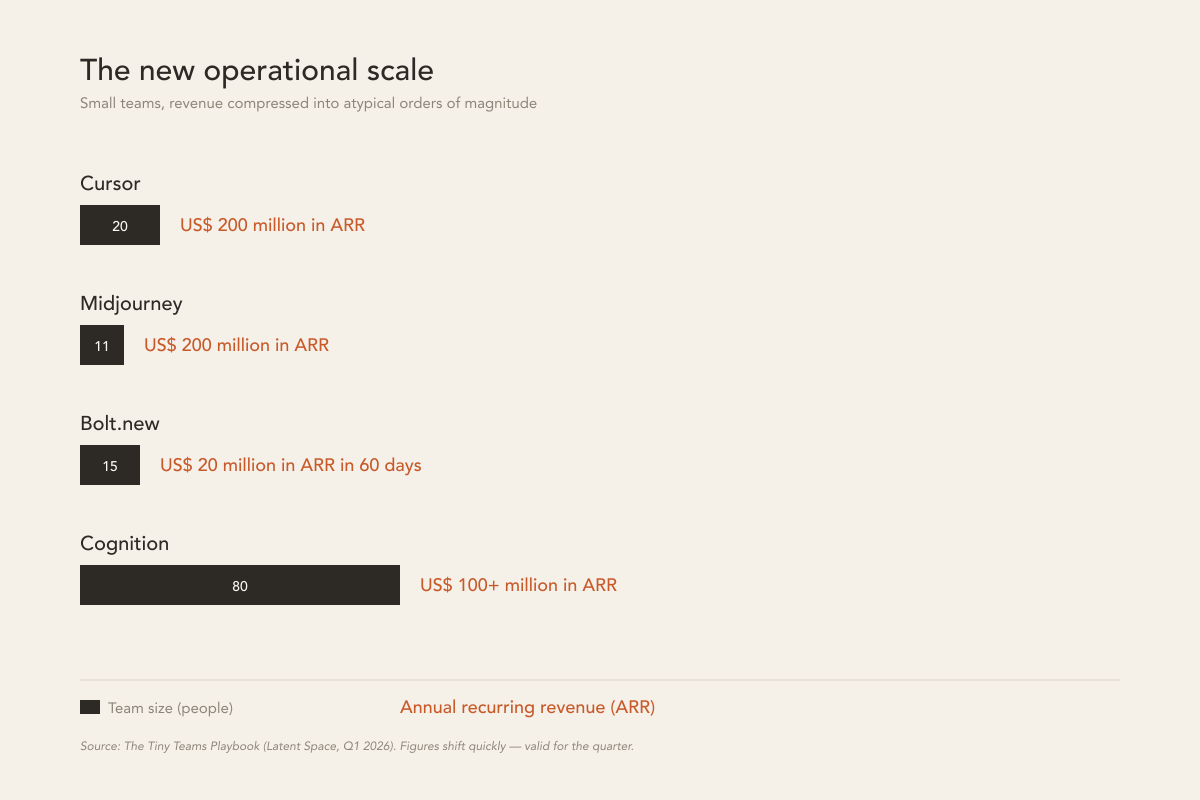
The three facts don’t make sense if you read them as cycle. They make sense if you read them as structural change: the default size of a team operating a digital product fell by an order of magnitude, and the market is going through the adjustment all at once.
Thiago Ghisi’s account
In January 2026, Thiago Ghisi published in his newsletter 30 days of his own engineering life. There were 289 AI-assisted coding sessions, across 19 projects, in seven different languages. An iOS app in nine days, written by someone who hadn’t touched Swift since 2018. Four Go projects in six weeks, starting from zero experience. Complex systems (vector stores, AST parsing, semantic search) delivered in 72 hours.
The sentence he closed the piece with captures what’s happening right now:
“The question is no longer ‘Can I ship this?’. It’s ‘Should I?’, and ‘What else could I build?’”
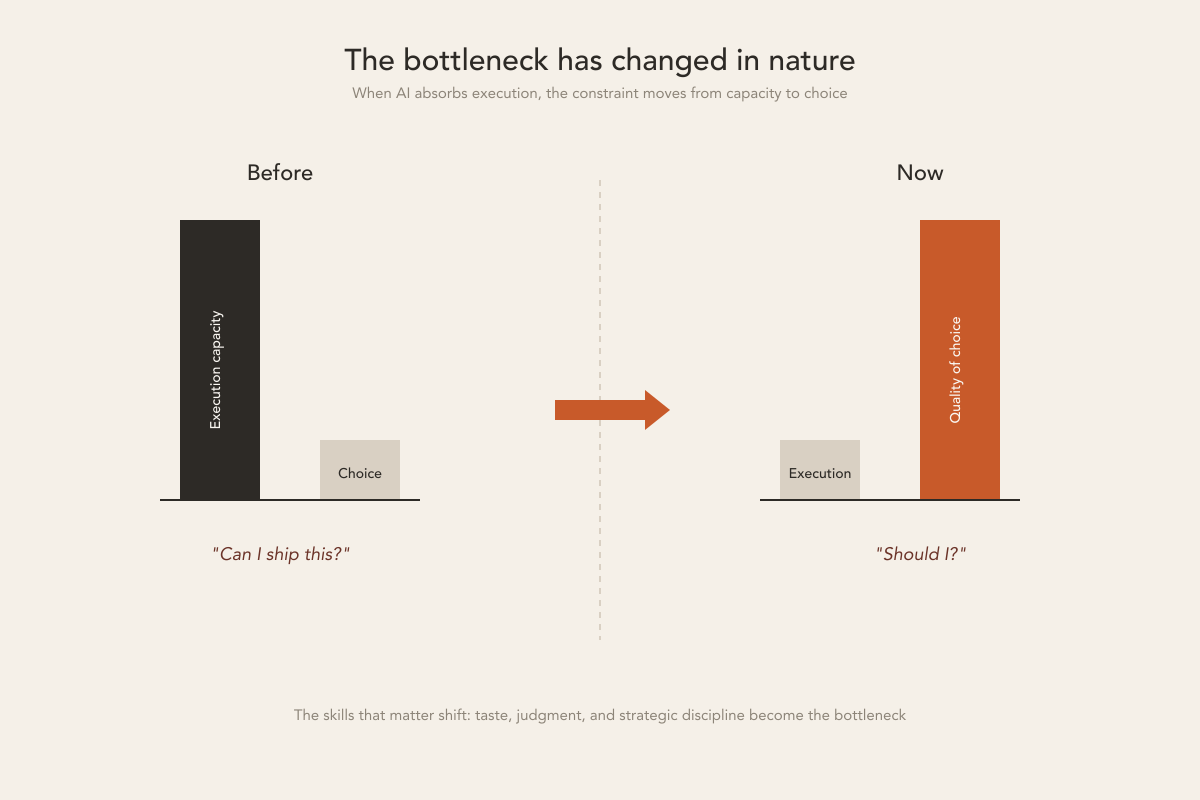
When the bottleneck shifts from execution capacity to quality of choice, the skills that matter change in nature. Load management, hour allocation, and brute-force implementation count less. Taste, judgment, and strategic discipline count more. Most engineers never needed to train these skills because, until recently, they had never been the bottleneck.
The bifurcation that demands an honest reading
On one side, tiny teams growing at absurdly compressed multiples. On the other, incumbents in a loop of layoffs, feeding the market the narrative of “AI productivity gains” as justification.
The honest reading requires two observations that break this view.
The first came from Bloomberg in April. The agency’s analysis of AI-attributed cuts found a pattern the public narrative wasn’t telling: roughly half of those positions will be refilled, but with offshore work or significantly lower salaries. Replacing humans with machines doesn’t cover the full picture. A good chunk of the cuts is, in fact, labour repricing dressed up as productivity gain. The cuts are not only structural; they also take advantage of a narrative window to reduce the cost of human capital without saying so out loud.
The second observation shows up in the reports themselves. The same numbers that show cuts show aggressive hiring in specific categories: AI engineering, platform, security. The total falls; the composition shifts. The real bifurcation is more subtle. Having AI in the company no longer differentiates anyone. What differentiates is which side of the restructuring is being built.
The generation no one is training
The least visible risk, and probably the most permanent, is in who’s not being hired.
Companies cutting junior devs today are creating a silent two-to-five-year hole in the pipeline. They won’t have experienced mid-levels in 2027-2029 because they didn’t hire the juniors who would have developed into them. METR points out that AI capability on coding tasks is doubling every seven months; the community splits between those betting on speed-first (no review, cover with speed) and quality-first (keep review, keep continuous delivery cycle). The two sides are building structurally different organizations for the rest of the decade.
The window to correct this decision is short. The cost of not correcting it doesn’t show up on the 2026 P&L. It shows up in 2028, when it’s time to hire mid-level.
LatAm against the tide
While New York and San Francisco lay off, São Paulo and Osasco hire. iFood appears in 2026 as one of the most active employers of software engineering and ML talent in Brazil, with packages ranging from R$ 110,000 to R$ 200,000 per year (according to Glassdoor and Levels.fyi) and full benefits. Itaú appears for the same reason, with AI roles in competitive ranges for the financial sector (Glassdoor 2026). Both are in expansion mode.
Brazil is at a different point on the curve. The critical question admits two readings. The first: healthy structural resistance, a market in catch-up that values available human talent for building internal capacity. The second: delay that will cost dearly eighteen months from now, when the compression hits hard and the teams built in the coming months are sized for a default that has already passed.
The answer is not obvious, and it matters greatly for anyone building an AI team in Brazil this year.
What this asks of each of us
For CEOs. The focus has shifted. Instead of asking “how many to cut,” the right question today is “what organizational architecture are we building on the other side of this bifurcation?” If you cut headcount without changing how the work is structured, what you gain is just the reduction in payroll. You capture none of the structural gain that’s available.
For CTOs. Harness matters more than headcount. Specification quality matters more than volume of code. StrongDM and Anthropic have already nailed this in practice; the rest of the industry is behind.
For managers. I know an engineering manager who spent the last five years optimizing hour allocation and managing load peaks. In January, he told me he no longer knew what to measure. The team was producing more; he couldn’t explain why. He was measuring the wrong thing because the bottleneck had shifted. The constraint flip demands a new set of skills (taste, judgment, decisions about what not to do) that no one has trained systematically. Whoever develops this first has a clear operational advantage.
For individuals in engineering. Think about that senior dev you know. Eight, ten, twelve years of career, knows the internals of the system, ships heavy features on schedule. Their training was implementation. The work is shifting to orchestration. They haven’t lost value. The value has shifted location. The skills that matter today (taste, judgment, specification) aren’t in the repertoire most have built, because those skills have never been the bottleneck. The ceiling has risen. The repertoire that opens the new ceiling is different from the one that opened the old.
Tiny teams is becoming the new default. It’s being built right now, while the industry discusses layoffs as if they were cyclical. Whoever understands compression as structural buys time. Whoever treats it as cycle misses the reset.
📗 Recent publications
Normal AI: The Pragmatic Counter-Narrative (issue #9, May 2025) + The 12.5% reality (issue #26, May 5, 2026).
This issue closes an arc that began a year ago. Three moments, one single movement.
In May 2025, in issue #9, I mapped the “Normal AI” movement (Dash, Narayanan, Kapoor) as a healthy counter to hype and catastrophism. The thesis was governance as design ethics, AI as integrable tool, human-centered future. At that moment, normalization seemed to be the path that opened space for responsible use.
In May 2026, in issue #26, I returned to the same ground with an uncomfortable measurement: the 12.5% reality. Four out of five organizations that tried putting AI into production saw no material return. The root cause wasn’t the model. It was the decoupling between decision-maker and operator, the excess of orphan pilots with no real owner.
This issue closes the arc. In the 12.5% that works, AI is rewriting what “team size” means. The compression is the permanent effect that remains after the normalization and the measurement have passed. Tiny teams as the new operational default is what “Normal AI” became in practice: not what the #9 argument anticipated, but what the empirical evidence of 2026 is building.
Normalization (2025), measurement (early 2026), permanent structural reorganization (now). One single movement, seen in three cuts.
🌎 What the world is saying…
For anyone who wants to go deeper into the two stories that structure this issue:
Linas Beliūnas — First One-Person Unicorn covers Steinberger and OpenClaw in detail, with the timeline, the numbers, and the operating pattern that makes the case possible.
Simon Willison — Software Factory covers the StrongDM Dark Factory in detail, with the declared operational heuristic and the digital twin universe of SaaS clones.
References
Linas Beliūnas (2026) — First One-Person Unicorn (Substack, February 2026). Timeline, numbers, and financial context of Peter Steinberger and OpenClaw, including personal spend of US$ 10-20K/month on tokens and the Meta vs OpenAI bidding war.
Simon Willison (2026) — Software Factory (simonwillison.net, February 2026). Coverage of the StrongDM Dark Factory, including the rule “Code must not be written by humans. Code must not be reviewed by humans.” and the heuristic “if you haven’t spent at least US$ 1,000 on tokens today per human engineer, your software factory has room for improvement.”
Thiago Ghisi (2026) — The Big Constraint Flip (Substack, January 2026). 289 AI-assisted coding sessions in 30 days, 19 projects, 7 languages. Closing line: “The question is no longer ‘Can I ship this?’. It’s ‘Should I?’, and ‘What else could I build?’”
India Today (2026) — If AI writes 100% code at Anthropic, what will engineers do? (February 2026). Boris Cherny’s statement at the Cisco AI Summit on the share close to 100% of code generated internally by Claude.
Latent Space — Shawn “swyx” Wang (2026) — The Tiny Teams Playbook. Coining of the “Tiny Teams” category, flagship list (Gamma, Bolt.new, Cursor, Midjourney, Cognition), and the heuristic “more m in ARR than employees.” Headcount cited in the body valid as of Q1 2026; numbers shift quickly.
CNN — Jordan Valinsky (2026) — Amazon Cuts 30,000 Corporate Employees in 3 Months (January 2026). 9% of corporate headcount cut by Andy Jassy with an explicit link to AI restructuring.
The New Stack — Steve Fenton (2026) — How AI Coding Makes Developers 56% Faster and 19% Slower (February 2026). Conflicting studies on AI-assisted productivity, speed-first vs quality-first polarization, hiring freeze for jr. devs, METR doubling-every-7-months.
Bloomberg (2026) — analysis of Q1 2026 layoffs suggesting that roughly half of AI-attributed positions will be refilled with offshore work or lower salaries (labour repricing).
Brian Armstrong (Coinbase, May 5, 2026) — email to employees announcing the 14% cut, verbatim quote: “I’ve watched engineers use AI to ship in days what used to take a team weeks.” Full email reproduced in Fast Company and coverage in Fortune.
Tech layoffs tracker Q1 2026 — 81,747 tech layoffs in the first quarter, 864 layoffs per day in May. Largest quarter in two years.
Glassdoor + Levels.fyi (2026) — Salary ranges for iFood (software engineering and ML, R$ 110-200K/year) and Itaú (AI roles, competitive ranges for the financial sector). Brazil in expansion phase for technical talent in 2026.