
The Optimistic Iconoclast - Issue #28
Becoming a commodity or betting on differentiation. Which side are you on?


A Thursday in May
A few days ago, I spoke with the CTO of a Brazilian B2B SaaS company. Roughly two dozen devs on the team. Heterogeneous stack, with Ruby, PHP, and Python coexisting in systems that range from monolithic legacy code written in 2015 to new services running on Kubernetes. CI/CD has gaps, observability is incomplete, and the pain of maintenance keeps growing.
The conversation’s nominal agenda was training. What he actually wanted was something else: to describe a concrete problem and hear an outside diagnosis.
The problem, as he described it, was that the team ships code but doesn’t talk to clients, doesn’t see the operation the software supports, doesn’t make architecture decisions. And he knew exactly what that meant in an environment where AI already produces decent code in all three languages the team uses. He said: “Today, building is easy. Knowing how to maintain is still the difference.”
The tone was recognition, not panic. And one clear question came out of the conversation: what’s left for the technical professional to do when the syntactic part of the work stops being where the value lives?
I’ll come back to this conversation later. It anchors this edition’s central argument. First, let’s look at the data point that made the question inevitable.
The measurement that changes the conversation
In April, Stanford published the 2026 edition of the AI Index. Chapter 2 contains a measurement worth pausing on: AI models now reach performance levels between 60% and 90% in tax, mortgage processing, corporate finance, and legal reasoning. Four high-value professional domains, measured simultaneously, with the top 15 models separated by just 3 percentage points.
In the previous edition, I described the constraint flip: the bottleneck stopped being execution and became judgment. Stanford now provides the empirical evidence of the same flip applied to four new professional domains.
Technical capability in these domains has become commodity. Stanford names the consequence directly: competitive pressure shifted axis, moving from raw capability toward cost, reliability, and domain-specific performance.
Commoditization has a known property. Anyone who only executes the technical part is closer and closer to the market price, which falls. What differentiates now lives somewhere else.
Back to the Thursday CTO. His team ships competent code, and competent code is exactly what’s becoming commodity. His question had empirical basis. He was correctly reading a data point he probably didn’t even know.
Circuit City, 2007
On March 28, 2007, Philip Schoonover, then CEO of Circuit City, fired 3,400 experienced salespeople in a single day. The company’s stock rose 1.9%. By April, sales started collapsing. In November 2008, the company filed for Chapter 11. Howard Yu, strategy professor in Lausanne, tells this story in an analysis published in March of this year and argues a specific thesis: what killed Circuit City wasn’t competition; it was the internal loss of the apparatus for reading its own operation. Schoonover fired without first going to the store to understand what the experienced salespeople knew and nobody else on the team had. In March 2007 nobody saw the problem. In November 2008 it had materialized.
Yu observes that this pattern is repeating now, with AI as a crutch or scapegoat. The first quarter of 2026 closed with more than 81,000 tech layoffs announced, the largest quarter in two years. Block/Square cut 40% of its workforce, around 4,000 employees, and CEO Jack Dorsey cited AI as the justification. Salesforce trimmed its support team from 9,000 to 5,000 people. Marc Benioff explained in an interview: “I’ve reduced it from 9,000 heads to about 5,000, because I need less heads.” WiseTech cut its workforce by 29%; CEO Zubin Appoo justified it: “The era of manually writing code as the core act of engineering is over.” X (formerly Twitter) is the case already materialized of this logic.
These cuts share one property in common. Nobody ran what Yu calls the Blue Shirt Test before announcing. That is: nobody went to the operation, before signing the memo, to understand what actually breaks when that layer of technical execution leaves. The Circuit City story isn’t being read.
That’s their mistake. The reader of this newsletter, in most cases, isn’t in that position. The reader is whoever is being affected by someone else’s decision. And for whoever is being affected, the question is different. It’s the one left open from the start.
What the CTO named
Back to the Thursday in May. At some point in the conversation, after describing the team and the maintenance pain, the CTO summarized the problem in a sentence worth pausing on:
“Writing code is commodity. Architecting isn’t for everyone. Developers need to learn to speak the language of business, not just technical languages.”
Stanford measured it. He named it. His sentence carries three moves in one. First, the empirical fact: the syntactic part of technical work has become commodity, and that’s done, not prediction. Second, the directional separation: architecture, in the broad sense, choosing what to do and how to organize operations so they work, remains the differentiator. Third, the actionable vector: speaking the language of business is what separates the relevant technical professional from the replaceable technical professional. That last point is old. For years, the sharper technical leaders have been telling their teams this. AI just sped up the clock.
There’s a recent data point that reinforces this reading from another angle. In May 2026, researchers from HBR, BCG, Boston University, and MIT published an experimental study with more than a thousand managers, directors, and executives on AI adoption in their organizations. One finding stands out: 76% of executives believe employees are excited about AI; only 31% of the employees themselves confirm. A 45-percentage-point perception gap between those who decide and those who operate.
This gap isn’t only evidence that senior leadership is disconnected (it is). It’s also a window. The professional who understands the operational context knows things the executive deciding headcount doesn’t. And that asymmetry, used well, is leverage.
Stanford itself recognizes that measuring AI alone no longer measures what matters. The field is shifting toward what they call centaur evaluations: assessments where humans and AI solve together. The reader who knows the domain is the half of the pair AI can’t train.
What’s left after AI absorbs the syntactic part falls into four pieces: knowing the business in depth (real client, real use case, what breaks in real operations); judgment situated in context (when to apply and when not to apply, knowing that AI goes from 89% success in controlled lab to 12% in real household environments, per Stanford itself); ability to instrument (observability, metrics, feedback loops, exactly the CTO’s explicit pain from Thursday); and translation across layers (speaking the language of business for the technical team, and the technical language for the business).
Nothing on this list is news. What changed is the relative weight. Before, these were desirable qualities. Now, they determine which side of the curve you’re on.
Who decides and who operates
Worth a thought experiment. Picture two people looking at the same team, from two different positions.
The executive, looking at the headcount spreadsheet, sees titles, costs, head/non-head, salary bands, seniority tier. That’s the reading the position offers and demands. The picture that shows up in the monthly report.
The professional on the team, looking at the day-to-day operation, knows the client who always calls on Monday because their use case has been unresolved since December. Knows the business rule sitting in a 2019 code comment, written by the dev who left the company in 2022 and that nobody else documented. Knows the way the sector’s regulation treats that specific type of transaction. Knows what actually breaks when the team changes the pipeline on a Friday before a holiday.
The difference between the two viewpoints is the leverage. And it’s only visible to whoever is looking at it. I argue that devs need to recognize that understanding the software to be written is worth more than writing it.
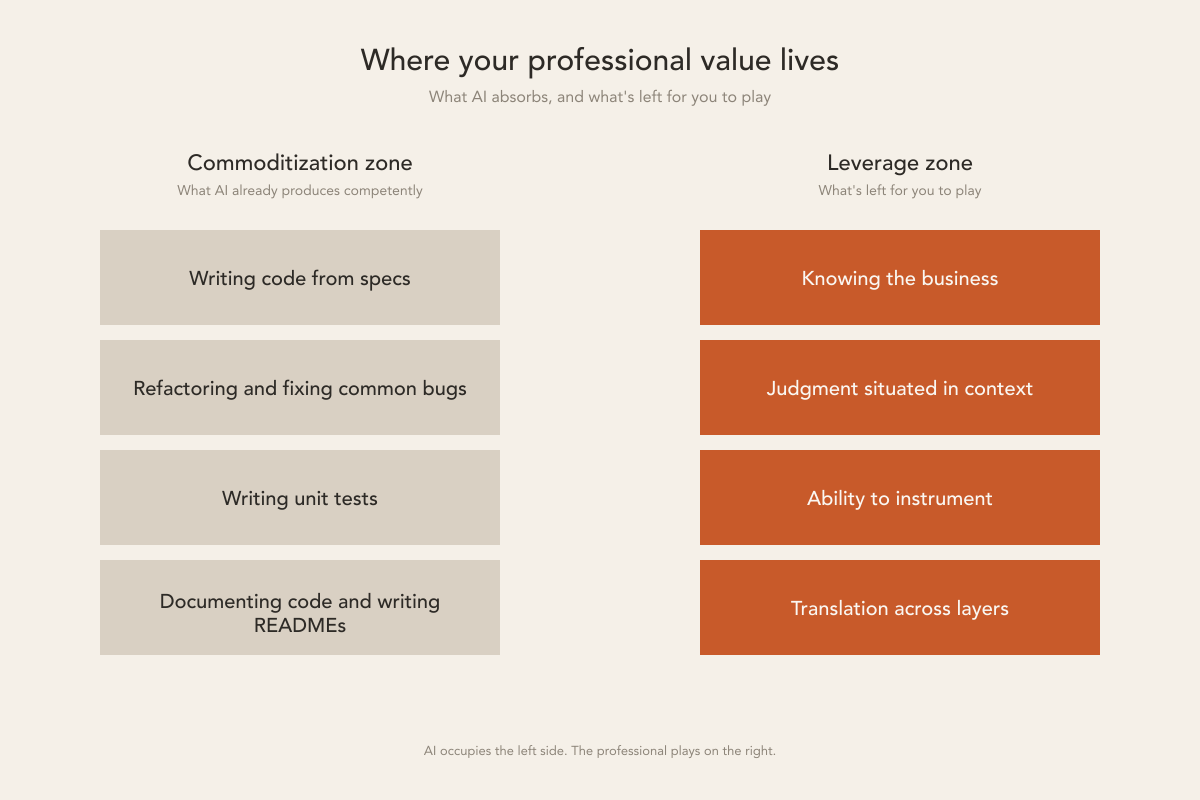
What’s being tested now isn’t the capacity to generate code. That one is turning into commodity in real time. It’s something else, harder to measure from outside and harder to lay off from inside: real proximity to the client, to operations, to context. What Howard Yu calls the “true-value question” works as a simple diagnostic for the reader. If you were laid off today and replaced by an AI agent, what’s the one move, the one piece of tacit knowledge, the one context decision the AI wouldn’t even know where to begin? Anyone who answers in thirty seconds is already in another position. Anyone who avoids the question is betting that the curve will stop advancing. The curve won’t stop advancing.
Resisting the curve was never a good plan
The developer who fought against new frameworks, against the cloud, against containerization, against no-code/low-code, ended up where? Generally in the same place as the developer who moved early, just much later. In every cycle, someone went all-in on what they considered their expertise and lost their footing when they discovered themselves obsolete in the next conversation. The curve didn’t come back. It didn’t come back for any of the previous waves and isn’t going to come back for any of the next ones.
Anyone who’s lived through this in tech recognizes the pattern from far. Anyone who hasn’t thinks it’s an exaggeration, until the first time they recognize themselves in the mirror.
The tax professional, the mortgage professional, the corporate finance professional, the legal reasoning professional is now where the developer was in 2010, roughly. At the start of this pattern, not in the middle of it. The difference compared to previous waves is that there aren’t at least fifteen years of notice accumulating. The curve arrived in all four domains at the same time, and that compresses the time to reorganize the bet calmly.
The correct reading of this scene is operational, not catastrophic. Investing in what the curve doesn’t catch (knowing the business, situated judgment, ability to instrument, translation across layers) is the displacement that works because it always worked. This is old. It’s what separates the relevant technical professional from the replaceable technical professional since before AI, and it’s worth more now because the syntactic part stopped charging for entry.
It’s not fair. It never was. But it’s how the game is played, and whoever recognizes that first plays better.
What’s left
That Thursday question has an answer. What’s left for the technical professional, and for the white-collar professional in general, is exactly what’s always been left when a layer of work commoditized: the part that catches context, decision, judgment, and translation. What changes now is just the speed at which the frontier moves.
The expertise that brought you here is unlikely to be what takes you forward. Whoever recognizes that while the curve still allows choice shifts the ground they play on. Whoever delays finds the ground already shifted.
The window exists. Whoever acts, acts now. Whoever waits has already waited too long.
📗 Recent publications
The pressure-readiness paradox (Issue #2, 10/31/2025)
I described, last October, a clear executive pattern: high pressure to “do something with AI,” at a moment of low organizational readiness.
Seven months later, the tension stopped being just a paradox. Pressure won. The organizations that described themselves as unprepared in 2025 are the same ones now laying off in the name of “AI restructuring,” and the lack of readiness wasn’t resolved; it was institutionalized through headcount cuts. That edition showed the start of the cycle. This week’s shifts the point of view: from the organizational paradox to what falls to the individual professional to do with it.
🌎 What the world is saying…
Howard Yu, “How Organizations Lose Their Minds: From Circuit City to the 2026 AI Layoffs” (Substack One Inch Ahead, 03/18/2026)
Howard Yu’s analysis, which anchors this edition’s argument, brings, beyond the Circuit City parallel, a four-phase model for diagnosing organizational decay:
information becomes fiction, with data systems obscuring real performance;
quarterly pressure distorts everything, with short-term metrics dominating strategy;
leadership abandons critical thinking, with signals from operations being ignored;
Blue Shirt Test as counter-example, with leaders who go to the operation recovering the capacity to read it.
If you’re an executive reading this, the exercise is worth doing: how many of the four phases are visible in your organization right now?
References
Stanford HAI — AI Index 2026, Chapter 2: Technical Performance, Jagged Intelligence, and the Convergence at the Frontier (April 2026). Model performance in professional domains (TaxEval, MortgageTax, CorpFin, CaseLaw, LegalBench) between 60% and 90%; top 15 separated by 3 percentage points; competitive pressure shifting toward cost, reliability, and domain-specific performance; lab/real-environment gap (RLBench 89.4% vs BEHAVIOR-1K 12%); proposal of centaur evaluations as the field’s direction. aiindex.stanford.edu/report
Howard Yu — “How Organizations Lose Their Minds: From Circuit City to the 2026 AI Layoffs” (Substack One Inch Ahead, March 18, 2026). Four-phase model of organizational decay; Blue Shirt Test; Circuit City 2007 → 2026 AI layoffs mirror; “true-value question”. howardyu.substack.com/p/how-organizations-lose-their-minds
Kropp, Bedard, Wiles, Hsu, Krayer — “Research: Why You Shouldn’t Treat AI Agents Like Employees” (Harvard Business Review, May 6, 2026; joint study HBR/BCG/Boston University/MIT). Experimental study with more than a thousand managers, directors, and executives. 45-percentage-point perception gap on AI adoption between executives (76% think employees are excited) and employees (only 31% confirm). hbr.org/2026/05/research-why-you-shouldnt-treat-ai-agents-like-employees
Layoffs.fyi — Tracker tech layoffs Q1 2026. More than 81,000 tech layoffs announced in the first quarter of 2026, the largest quarter since early 2023. layoffs.fyi
Block/Square — 40% workforce cut (around 4,000 employees) announced February 26-27, 2026, with Jack Dorsey citing “intelligence tools” and the progress of AI models as justification. CNN Business | Fortune
Salesforce — cut of 4,000 customer support positions (from 9,000 to 5,000) confirmed by Marc Benioff in September 2025: “I’ve reduced it from 9,000 heads to about 5,000, because I need less heads.” CNBC
WiseTech Global — cut of around 2,000 positions (29% of workforce) announced on February 25, 2026. CEO Zubin Appoo: “The era of manually writing code as the core act of engineering is over.” Reuters via Yahoo Finance